Tuesday, July 16, 2013

The Impacted and the Ignorant (or Those Who Get It and Those Who Don't)


Soooo… that title is a little judgmental. I guess I feel I’m entitled. Every month, numerous times, I put myself out there with our story, sharing Dustin’s life and death across three counties at DUI and MIP Victim Impact Panels, and High Risk Driver and Share the Road classes. This is a labor of love for my son: to keep his memory alive, to make his death meaningful, and to help others understand the importance of responsible driving so they don’t have to suffer the consequences we have. Or inflict them on others.
At the end of every class, participants complete an evaluation so the organization can determine what is working and what isn’t. I anxiously and eagerly wait to see these evaluations myself. If I’m leaving a class and I’m handed the previous weeks’, I read them in the car. If they come in the mail, they’re out of the envelope before I’m in the house.

The major part of the form instructs the participants to rate various aspects of the class on a scale of 1 to 5 (videos, lecture, laws, etc). Then they are asked what impacted them most and what could be improved. These two questions are usually where I am mentioned… but not always. Not even most of the time, specifically. Often people will write “the speakers” or “cop talk” impacted them most, and for what could be improved it’s usually “more comfortable seats” or “more breaks.” 

The vast majority of people seem to come to the classes expecting to be lectured and made to feel guilty and they leave saying they loved the classes, did not feel judged, and think everyone should be required to attend. Often they'll say they'd like to bring others to the class.
The following are actual comments. They have either buoyed me up and made me more determined or, alternatively, deflated me and made me question my effectiveness and whether I should continue. And… some just make me mad (you know, the ignorant ones).
What did you find most effective or made the most impact in class?

“The stories of the survivors but Finney really broke my heart.”
“The emotional loss of a child was the most powerful.”

“The presence of Dustin’s ashes was quite moving and his mother’s grief affected me, a father, greatly.”
“Kristi was so brave and moving. Seeing the box of ashes was moving.”

“The stories were real, full of pain. Life is so fragile.”
“Stories – the last especially. Her son is my age, we have a lot in common, and I remember when he was killed.”

“Dustin’s mom. She touched my heart and brought the realities truly to my attention.”
“A kid under 21 was drinking and hit a guy riding a bike and the guy died. It’s sad.”

“A mother who lost a child, and is able to forgive this person for what they did.”
“Kristi seemed like everyone’s kind of mom.”
(There are many, many other comments about other speakers, including but not limited to Jim – an energetic and entertaining but effective trauma nurse who facilitates, Tyler Presnell – a young man severely injured in a speed-related crash who is now a paid motivational speaker about traumatic brain injury and “respecting the journey” when driving and in life in general, Joan – the victim of a hit-and-run drunk driver who now lives with severe traumatic brain injury and has started a non-profit agency regarding TBI, and Judges Silver and Larsen – mediators of the VIP and Share the Road classes respectively).

What suggestions do you have to improve the course?
“Victim panel wasn’t as relevant considering it was a homicide.”

“Don’t show a pic of someone’s dead son. I appreciated the story but not the pic.”
“…Not so good part: the picture of the dead little boy was a bit too much. There is likely a better picture that can prove the point and not show a dead child.”

“Not have the class at all.”
And my all time most memorable:

“Disliked story of the dead son. It was overcriminalization of the already convicted.” (Huh?)
Interestingly enough, the criticisms are all almost exclusively from the Share the Road class, which is for those people with relatively minor tickets. Because of the feedback, I did remove the picture of Dustin in his coffin from that presentation. It remains for the other classes, though, because the consequences of driving drunk, drugged, and/or recklessly, are not gentle, are not pretty, are not comfortable.

Our family was not given the option to make it less "graphic." I refuse to soften it up for the drivers endangering everyone on the road (including themselves).

Thursday, July 11, 2013

Creating the Tragic Story


For some, death is a long, slow and heart-breaking journey. For others, it is an abrupt cessation of an active life.

My mom lived 3 years with lung cancer. Three long years of treatment and hope and uncertainty and sickness and diminished quality of life. I say “long” years but I wonder if Mom experienced them that way. Maybe those years went by quickly for her. I suspect, though, that she experienced it both ways: time went too fast and too slow simultaneously.

During her illness, I became closer to Mom than I had ever been. I felt her love more than I had any other time before. It was upsetting to see her sick, to know that she was going to miss out on so much from dying so young. Mom would not know her grandchildren. And even though I knew it was coming, when she did pass away, it was still a shock. It was still distressing and unbelievable. One minute she was alive and the next she wasn’t. One minute there was still some hope, some comfort, and the next only loneliness and grief. Mom’s story ended.

My son was very much alive. Dustin was healthy and enthusiastic and dynamic and energetic. Then he was dead. Deceased. Lifeless. Inanimate. “Gone.” In a split second. No warning. No buffer. No “getting used to the idea” ahead of time. And especially, no time to say good-bye.

For him, I am happy about that. No pain. No fear. No sadness. No regrets.

For me and for the others who love him, though, there is pain and sadness and regrets. And there are questions.

A bereavement group explained that a major difference between a slow, expected death like my mother’s and an unforeseen death such as Dustin’s is “the story.” With Mom, we knew the story of diagnosis and treatment and continuing illness and eventual death. With Dustin, bam! he just ceased to exist any longer. There was no story.

So the survivors struggle to create the story. In my case, I went to the site of the crash. I put my fingers in what remained of his blood on the road. I measured the distance between where he was hit and where he ended up. I photographed from one end to the other and from above as well. I drove the route he had ridden his bike that night. I drove the route the person who killed him drove. I read police reports. I read everything in the media or online that I could find. I talked to the medical examiner. I asked where he’d been and why. I picked up his belongings from police evidence and analyzed it all: the destroyed bike, the bloodied books, the scraped up but still working cell phone. I found out what I could about the person who killed him.

I’ve tried to piece together a coherent story, to make sense of the senseless. What happened? How did it happen? Why did it happen? And why did it have to happen to him?

This post is the result of unexpectedly meeting a young man who had an experience that I desperately wanted to learn more about but was afraid to question. This young man was the first to see my son after someone else plowed into him and left him on the street, who testified before the grand jury and was instrumental in the decision to charge that driver with Manslaughter. We met and hugged and cried together. We exchanged phone numbers. Other than asking him if Dustin was dead when he first saw him (Yes! my most fervent desire), I managed to stifle all other questions. What I really wanted was to somehow get inside his mind and see what he saw and hear what he heard and feel what he felt so I would know more of the story. But I didn’t want to put him through that. Maybe I don’t really want to know, myself.

…No, I do. I do want to know.

Tuesday, July 9, 2013

Close call... or Some Parents are Really F'd Up


I admit from the outset that I am riled up. Emotional. Angry. Disgusted. Despairing.

Picture SR 500 westbound at St John’s Blvd. I enter the highway and with no one in sight, I move all the way into the left lane. Within seconds, a black car races past me on the right. Immediately after, a second black car races past. I'm already up to 55, so I figure they're probably going at least 75. The cars swerve around a vehicle in front of me, approaching the corner after which SR 500 merges with I-5. A third black car races past me. I wonder if that car is with the other two – it was a little behind – and decide that it is, just trying to catch up. They're racing  (hence my use of the word “races” so many times).

I think, “Someone’s going to get hurt.” But I’m entering the corner myself and with an entrance ramp on the right and I-5 on the left, I decide to wait before calling 911. Too late.

Suddenly smoke fills the air, and I brake hard to keep from hitting the vehicle in front of me, which barely avoids hitting the vehicle that has crashed in front of it. The new, black BMW is perpendicular across the left lane, its smashed front end pointing toward I-5. I’m frantically thinking, “Please don’t make me see something bad, please don’t make me see something really bad.” Images of crash scenes I’ve seen at the Victim Impact Panels and High Risk Driver Classes flash through my mind. I’m actually on my way to speak at one. 

I hear screams and the driver in front of me is already pulling two young children out of the wrecked car. They are huddling together for comfort and the driver of the BMW extricates himself and rushes over, too. Another vehicle stops and the kids are taken into that car, in the care of two motherly looking women.

The driver is big (as in buff), tall,  and bald or nearly so. He looks like a macho man. He blames the other drivers for the crash. He complains that the airbag hurt his arm. He starts picking up pieces of his car and putting them in a pile. Meanwhile, his children are in a car with people they don’t know after experiencing a terrifying wreck.

I whisper with the woman driver of the other car. She didn’t see the actual crash either, because she was still back around the corner when it happened. But she’s hot. She says, “They were racing and I couldn’t believe it when he passed me and I saw the children in the car. I said to my husband, they’re [the racing drivers] going to kill someone.” She confides that she asked the older child what happened, and the child cried, “Dad was racing like he always does.” She looks at me with fury and says, “If he’d hurt one of those children, I’d have punched him right there.”

She has her own child in her car and I have the ashes of my dead child - killed by a different selfish, reckless driver - in my car. We hug. 

Two fire engines, an ambulance, and two police cars finally arrive. The father’s arm is put in a brace and he is questioned, then the kids, the other woman driver, and then me. The police officer takes my contact information but is clearly disappointed that I didn’t actually witness the wreck or what led up to it, other than 3 cars were racing each other around a corner. 
 

It appears that no one was hurt. Not physically anyway. “Dad was racing like he always does.” This sounds like emotional pain to me, the words of a child who has been in that car and feared for her life before. And felt helpless to do anything about it. 

I wish I could have stuck around to see if that father was arrested, because he deserved to be. He endangered himself, his children, and multiple others due to his selfish, reckless behavior. And other cars could have slammed into us, too, making a relatively minor crash into someone's worst nightmare. 


Seeing this utter lack of regard for other people distresses me. That’s putting it mildly. And it just keeps happening.

Thursday, July 4, 2013

In Dustin's own words, July 2005


A day in the life of Dustin, July 2005, in his own words, plus some photos of him taken 7/4/2011:

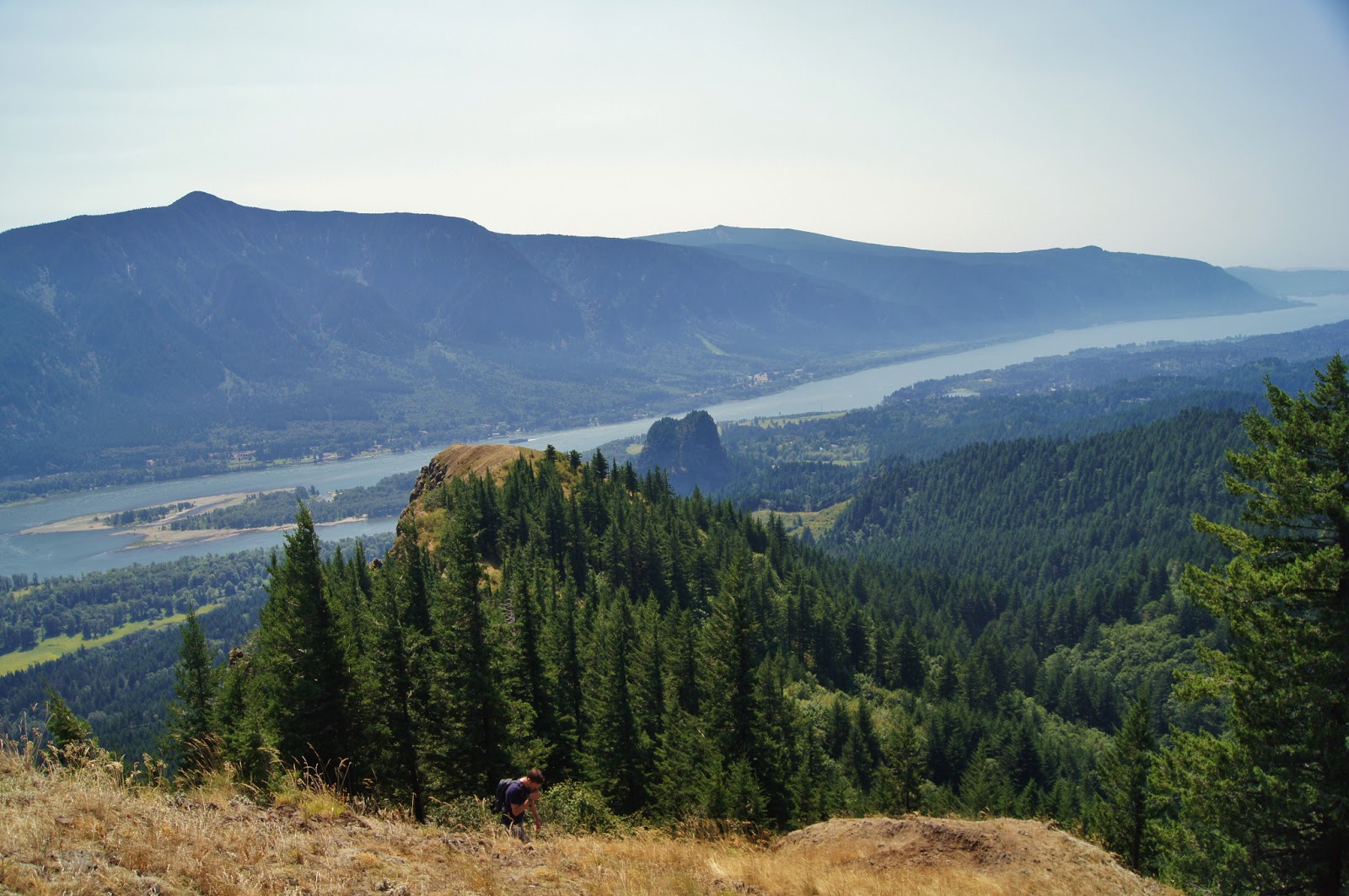
“I took a grueling bike ride to Beacon Rock State Park yesterday, hiking four miles to the top of Hamilton Mountain then down again for the ride back.
Beacon Rock from Hamilton Mt 8/12/12 (Anniversary Hike)
The route consists mainly of level ground from here [Vancouver] to Washougal then proceeds over a series of smaller hills as it approaches the [Columbia River] Gorge. The most arduous part of the trip is about 1/3 of the way into it when the road winds up into the mountains. The river, recently so near, is now hundreds of feet below. Eventually after reaching the end of the this climb, I enjoyed a long coast back down the other side of the mountain, though the knowledge that I would be obliged to climb back up again made it quite bittersweet.

“As usual, the Hamilton Mountain hike was awesome. I was, initially, slow-moving, being worn out from the ride but, just as the going got really tough, the Gatorade and two corn dogs I bought from a mini-mart kicked in, giving me a second wind.

Bonneville Dam from Hamilton Mt 8/12/12
“I don’t believe I’ve ever seen so many butterflies. One fluttered along in front of me for a good twenty-five yards…

“Upon reaching the summit, I beheld a panoramic view of the gorge adjacent to Bonneville Dam. I was a little dismayed by the smog level. I stood wondering how beautiful it might have been when none but the Indians lived in this land.”


He then continued with some thoughts about himself, in an ongoing attempt to boost his self-confidence and also to determine where he needed to make changes (per other journal entries):
Dustin 7/4/11, Mt Adams in background
 
“Things I like about myself:
“I am intelligent and contemplative, with a good command of English and an amount of knowledge not typical my age.
“I am thoughtful, with a desire to do good and see people happy.
 “I keep myself in good shape and hold myself to a high standard of fitness.
“I am good-looking in the face.

 “Things I dislike about myself:
“I am stern of countenance and appear unfriendly to people.
“I am reluctant to talk to girls for fear of rejection.
“I am irritable and sometimes temperamental.
“I allow myself to eat large amounts of food, compromising my fitness.”

I am so proud of my son and so happy that I had 28 years with him. 28 years to see him grow into such a caring and dedicated person, a man of high integrity who was true to himself. He is not only my motivation but my inspiration. He was not afraid to speak up for what he believed in and that is what I strive for as well. Because of him and my other children and husband, I hope to save lives by telling our story and sharing other devastating and preventable stories as well. "Drive safely" is not just another way to say "I love you."
Dustin with Bigfoot, near Mt St Helens 7/4/11


Dustin with 2 siblings, Logan and Jenna 7/4/11

Sunday, June 9, 2013

Hit 'Em Where It Hurts: Hit-and-Run


My testimony before the Senate Judiciary Committee in early May, regarding the need for increased penalties for injury hit-and-run (with the addition of pictures and a news article):

My name is Kristi Finney and I am the mother of a young man killed by a hit-and-run driver. I’ve learned the hard way why we need to get tougher on this crime.

In August 2011, two young men were struck by an SUV traveling in the bike lane. The vehicle first hit my son Dustin, throwing him 175 feet, over the head of 17 year old Kevin, who was then also hit. The driver “took off as if nothing happened.”
Dustin died at the scene; Kevin had minor injuries. An 18 year old male, caught within the hour and with a blood alcohol level of .169 three hours after the crash, eventually pleaded guilty to Criminally Negligent Homicide, Felony Hit-and-Run, DUII, and Vehicular Assault of a Bicyclist. He is serving 5 years in prison with a possible 20% time off for good behavior.

We took the guilty plea rather than go to trial for Manslaughter because the District Attorney felt the case wasn’t strong enough to win a conviction: no one had seen the driver. The defendant was covered in glass, his own blood was in the vehicle, his fingerprints were on the door handle, and his girlfriend admitted she gave him the car to drive, but no one could testify they saw him behind the wheel.

What I’ve learned since my son’s death is that when one person hits another and then makes the decision to leave that person on the road like garbage, uncaring of their degree of injury (whether death, traumatic brain injury, or a scraped knee), the driver has stacked the legal deck in their own favor. Leaving is often the best thing they can do for themselves. Sometimes they get away with their crime entirely. Sometimes they turn themselves in later, after they’ve had time to sober up and/or seek legal representation. Sometimes they are caught despite their best efforts to run but even then, leaving was somehow usually to their benefit, as in our case.

In my research of hit-and-run crashes, I’ve rarely, if ever, seen a driver who didn’t have some issue other than just leaving the scene. There was a reason they left and it wasn’t just “I was afraid” or “I didn’t know I hit anybody.” These drivers were impaired by drugs or alcohol, they were using their phone, they were driving while suspended, they had previous reckless driving infractions, they had outstanding warrants, or they were in the commission of another crime (i.e., car was stolen), etc. Below is the title of an Oregonian article in Dustin's case http://www.oregonlive.com/portland/index.ssf/2011/08/suspect_in_early_morning_fatal.html:

Suspect in early morning fatal hit-and-run has record of traffic, juvenile violations


Tammi with son Harley, killed in hit-and-run; driver at large
A person who leaves the scene of a crash, especially an injury crash, is not innocent. They are selfish and uncaring. What if by staying they could have prevented a death or at least seriousness of injury? What if by staying they could have prevented a second or third vehicle from further hurting the victim? What if they could have comforted a critically injured person instead of leaving them to die or suffer alone? The cry of every mother of every injured person in a hit-and-run is “How could someone just leave my child alone like that?” We never look at people the same way again. We no longer trust anybody. We know it can happen to us and we wonder when it will happen again. Every new hit-and-run is another blow.

During the sentencing in my son’s case, the consequence that appeared to most upset the young man who killed Dustin was that he has lost his driver’s license for life. I ask you to please vote for HB 2542. Hit-and-run is serious. Let’s get serious about consequences. Thank you.

The House and Senate passed unanimously for the bill.