Sunday, June 9, 2013

Hit 'Em Where It Hurts: Hit-and-Run


My testimony before the Senate Judiciary Committee in early May, regarding the need for increased penalties for injury hit-and-run (with the addition of pictures and a news article):

My name is Kristi Finney and I am the mother of a young man killed by a hit-and-run driver. I’ve learned the hard way why we need to get tougher on this crime.

In August 2011, two young men were struck by an SUV traveling in the bike lane. The vehicle first hit my son Dustin, throwing him 175 feet, over the head of 17 year old Kevin, who was then also hit. The driver “took off as if nothing happened.”
Dustin died at the scene; Kevin had minor injuries. An 18 year old male, caught within the hour and with a blood alcohol level of .169 three hours after the crash, eventually pleaded guilty to Criminally Negligent Homicide, Felony Hit-and-Run, DUII, and Vehicular Assault of a Bicyclist. He is serving 5 years in prison with a possible 20% time off for good behavior.

We took the guilty plea rather than go to trial for Manslaughter because the District Attorney felt the case wasn’t strong enough to win a conviction: no one had seen the driver. The defendant was covered in glass, his own blood was in the vehicle, his fingerprints were on the door handle, and his girlfriend admitted she gave him the car to drive, but no one could testify they saw him behind the wheel.

What I’ve learned since my son’s death is that when one person hits another and then makes the decision to leave that person on the road like garbage, uncaring of their degree of injury (whether death, traumatic brain injury, or a scraped knee), the driver has stacked the legal deck in their own favor. Leaving is often the best thing they can do for themselves. Sometimes they get away with their crime entirely. Sometimes they turn themselves in later, after they’ve had time to sober up and/or seek legal representation. Sometimes they are caught despite their best efforts to run but even then, leaving was somehow usually to their benefit, as in our case.

In my research of hit-and-run crashes, I’ve rarely, if ever, seen a driver who didn’t have some issue other than just leaving the scene. There was a reason they left and it wasn’t just “I was afraid” or “I didn’t know I hit anybody.” These drivers were impaired by drugs or alcohol, they were using their phone, they were driving while suspended, they had previous reckless driving infractions, they had outstanding warrants, or they were in the commission of another crime (i.e., car was stolen), etc. Below is the title of an Oregonian article in Dustin's case http://www.oregonlive.com/portland/index.ssf/2011/08/suspect_in_early_morning_fatal.html:

Suspect in early morning fatal hit-and-run has record of traffic, juvenile violations


Tammi with son Harley, killed in hit-and-run; driver at large
A person who leaves the scene of a crash, especially an injury crash, is not innocent. They are selfish and uncaring. What if by staying they could have prevented a death or at least seriousness of injury? What if by staying they could have prevented a second or third vehicle from further hurting the victim? What if they could have comforted a critically injured person instead of leaving them to die or suffer alone? The cry of every mother of every injured person in a hit-and-run is “How could someone just leave my child alone like that?” We never look at people the same way again. We no longer trust anybody. We know it can happen to us and we wonder when it will happen again. Every new hit-and-run is another blow.

During the sentencing in my son’s case, the consequence that appeared to most upset the young man who killed Dustin was that he has lost his driver’s license for life. I ask you to please vote for HB 2542. Hit-and-run is serious. Let’s get serious about consequences. Thank you.

The House and Senate passed unanimously for the bill. 

Sunday, May 26, 2013

To do or not to do? That was the question.


“…because you don’t want this to be the last picture of your child, or anyone else’s, and know that it was totally 100% preventable.” (Click to picture of Dustin in his casket). 

This is how I end my presentations at the various DUII and High Risk Driver classes I speak for, when I’m encouraging everyone to drive more safely and to think of others. (Remember: Everyone on the road is someone’s child). 

I thought long and hard about whether I should use this picture or not, with my first consideration being, How would Dustin feel about it? Would he want a picture like that of himself seen? I decided that a few years ago he probably wouldn’t have but that in the last year or so of his life he’d ponder it for just a few seconds and then say “Go for it, Mom. Anything that’ll work.” He wanted results in his own endeavors and I know that he would encourage me to do what it takes to get the results I’m aiming for. I’m sure he would say, “Why would I care anymore?” (Sad feelings for me now).

Another consideration was whether this picture would actually get the results I want. Is it too much? Would I offend people? Anyone who was able to attend the viewing of Dustin before he was cremated knows that he was in amazingly good shape (at least what we could see of him) for what had happened to him. He was beautiful and intact and while I wouldn’t go so far as to say he looked peaceful, at least he didn’t look like he wasn’t peaceful. I guess what I’m trying to say is that the picture  isn’t offensive or gruesome other than the fact that any picture of a dead young man killed in the prime of his life is offensive and gruesome. 

I’m not posting the picture here. Or anywhere on the internet. When I show it on the big screen in class, I have total control over who sees it and why and for how long. It’s up for maybe 10 seconds before I move on to one of my favorite pictures of Dustin, the one he asked us to take at Lower Falls Campground on July 31, 2011, the last time we saw him. He was hoping for a good facebook profile picture. I like to think he would have been pleased. 

(This is the first in a series of blogs about speaking publicly about the tragedy of Dustin’s death and the devastating sadness felt by his mother.)

Sunday, March 24, 2013

Forgive, but with consequences


It would be horrible to kill your best friend. I get that. But that doesn’t necessarily mean that you’ve learned your lesson and should get off with just “living with having killed someone” as your only consequence, even if your best friend’s own mother doesn’t want you to suffer, too.

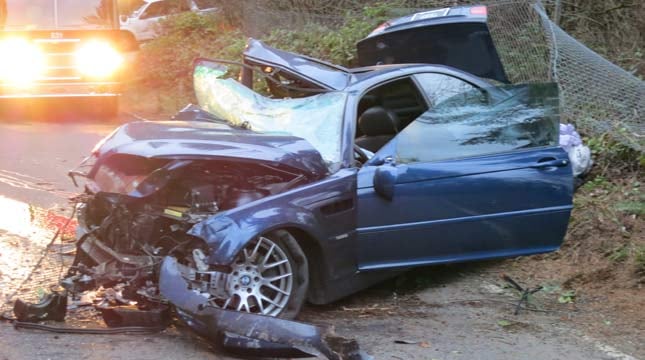
BMW, taken by KPTV
According to news reports, 18 year olds Yuriy Tasmaly and Mikhail Golovach took a friend’s car without permission to go on a “joy ride” after a night of drinking. Yuriy lost control of the vehicle and slid into a tree. Emergency personnel responding to reports of a crash found Mikhail dead in the car and the driver missing. Yuriy was eventually found about two miles away and taken to the hospital with his own minor injuries and to “sober up.” He was then arrested. Bail is set at $200,000.

Yuriy Tasmaly, taken by The Columbian
Numerous friends and family have shown support for him, including Mikhails’ own girlfriend and mother. Comments friends have made are “now we all have Yurka's back because we can't stand the thought of losing him, too,” “he would never ditch his friend. If I was in shock I would probably do the same thing,” and “most of the charges are without basis.”

"Most of the charges are without basis." Vehicular homicide, hit-and-run, driving while suspended, minor in possession of alcohol, theft of a motor vehicle... An intoxicated 18 year old, using a car he didn't have permission to use (whose owner reported it stolen), drove while his license was suspended (due to previous instances of recklessness and drunkenness), and killed another person then left the scene. No basis? Even if given the benefit of the doubt on the hit-and-run (some say he left to get help), there is certainly basis.

I'm sorry for both families. I know that the pain of losing a loved one forever and of losing another to prison is devastating, but there must be severe consequences for someone who had already had opportunities to stop and learn. Sometimes prison is the help some people need to learn they don't have the right to risk other people's lives for their own selfish desires. It's too bad that not only the person responsible pays, so do friends and family who love him. And it’s also difficult, perhaps, for friends and family to understand that it’s not enough for them to think “he’s learned his lesson, don’t punish him more,” when he endangered everyone on the road, not just the person who knew he’d been drinking and chose to get in the car with him anyway. Everybody has a stake in this, not just family.

Ashawntae and Dustin. Picture by Jonathan Maus
My son was killed by a drunk 18 year old who left the scene. I now speak at numerous victim impact panels (maybe Yuriy attended one I spoke at last year), and I have also forgiven the person who killed Dustin. I’ve even met with him in prison. But Ashawntae, too, had already been in trouble: a previous property damage hit-and-run, possession of ecstasy, etc. Obviously he had learned nothing, because he was still on probation when he killed Dustin. I forgive him, I’m supporting him, but he needs harsher consequences than just living with the knowledge he took another young man’s life.

It is very sad what some people do to other people and it is very sad they often have to learn the hard way. Yuriy is lucky. He has a second chance... It will be hard but he can make a better future for himself. And a safer one for everyone else on the road with him.

Thursday, March 21, 2013

Sex, drugs, and traffic safety, Part 1


Sex, drugs and traffic safety… what we need to be talking to our teens about.

Sex, yeah, we know that. Drugs? Obviously. And of course we talk to our teenagers about driving safely. Of course we do! Maybe you’re wondering what I’m talking about since most parents already (think they) do this.

Logan, practicing driving
I know I was a responsible parent to my teen drivers, paying for them to attend Driver’s Education classes, taking them out on the road for practice, practice, practice, even though anyone who has done this knows it is not fun. It is not fun! And I have never had a moving violation of any type so I was role-modeling good driving, right? Good driver, good parent, doing the right things as far as I knew. Not even questioning it.

But back to talking about traffic safety. I realize now that I really didn’t do that, at least not more than just superficially. And that is because I didn’t “get it.” I didn’t understand then – because I didn’t think about it - that driving is the most dangerous thing we do every day. Now I “get it:” Driving is not only the most dangerous thing we do every day, but it is a dangerous thing we do every day. Does that distinction make sense?

Today, I am going to focus on why it is important to talk about – and insist on the use of – seat belts. I learned these facts and statistics from 2009 recently... okay, today!:

*61% of 16-20 year olds killed in crashes were not wearing their seat belts. 61%!
*Males are much more likely to not wear seat belts than females.
*Nearly twice as many males were killed as females (this is not differentiated by seat belt use).
*Seat belt use reduces risk of fatal injury by 45% and of moderate-to-critical injury by 50% for front seat car passengers, while it reduces fatal injury by 60% and moderate-to-critical injury by 65% for truck passengers.
*Only 1% of seat belt users were totally ejected from a vehicle, which is one of the most injurious circumstances that can happen in a crash.
*Of those who were totally ejected from a vehicle, 31% were not wearing restraints.
*Of those ejected totally from a vehicle, 77% were killed.
*Drivers under the influence of intoxicants are much more likely not to wear seat belts.  

This link has further information, including links to even more information: http://www.underyourinfluence.org/seat-belts-save

I can remember back in the 70s being the first person in my family to consistently wear my safety belt; I don’t even know why, since the others weren’t. With my own kids, we always wore our seat belts without fail. Now I know why that was truly a good decision. And yes, good role-modeling.

Buckle up. It does save lives. And… it is easier to talk about to our teenagers than sex.